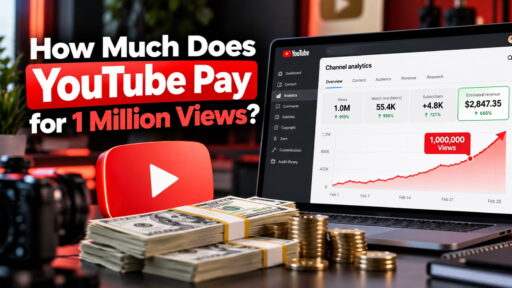
YouTube Shorts earnings and long-form video earnings come from different advertising and revenue-sharing systems. A creator comparing the two formats needs to understand what YouTube counts, where the advertising revenue originates, and why the same public view count cannot be converted into guaranteed payouts using one fixed rate.
Quick answer: Eligible long-form Watch Page ads generally pay participating creators a share of qualifying advertising revenue associated with their watch-page content. Shorts Feed ads instead contribute to a pooled allocation system, with participating creators receiving 45% of their allocated Creator Pool revenue. The two formats use different view and RPM definitions.
How Monetization Works for Long-Form YouTube Videos
Watch Page Advertising Revenue
For eligible creators who accept the Watch Page Monetization Module, YouTube describes a 55% share of net revenues from applicable ads shown on the public watch page. This figure concerns the specified revenue base; it does not mean that every thousand video views earns 55% of an advertiser-reported CPM figure. Some views have no monetized ad playback, and a playback can involve several ad impressions.
Other Revenue Sources on Long-Form Content
Depending on eligibility and product availability, creators may also receive YouTube Premium revenue, channel memberships, and eligible fan-funding income. RPM can combine multiple eligible YouTube revenue sources. A sponsorship paid directly by an advertiser to a creator is generally outside platform RPM, even though it can be an important part of the creator’s business income.
How Shorts Feed Revenue Sharing Works
Advertising Revenue Is Collected Into a Pool
YouTube collects eligible advertising revenue from ads displayed between Shorts in the Shorts Feed, then calculates the Creator Pool under its monetization policy. Music licensing can affect the amount assigned to the Creator Pool, but YouTube’s official explanation says music usage does not change the individual participating creator’s 45% share of the amount allocated to them.
Creator Allocation Depends on Eligible Engaged Views
The applicable share of the Creator Pool is allocated according to each eligible creator’s share of relevant engaged Shorts views by country. Views that fail monetization requirements, such as artificial traffic or certain non-original uploads, are ineligible. A creator must also meet applicable YouTube Partner Program conditions and accept the Shorts Monetization Module. Review eligibility rules at publication because platform policies can change.
Shorts vs Long-Form: Practical Differences
| Question | Long-form Watch Page | Shorts Feed |
|---|---|---|
| Where eligible ad revenue arises | Watch-page advertising | Ads between Shorts in the feed |
| Core revenue structure | Applicable Watch Page revenue sharing | Country-based Creator Pool allocation |
| Described creator ad share | 55% of applicable net Watch Page ad revenue | 45% of allocated Creator Pool revenue |
| RPM denominator | Video views | Engaged Shorts views |
| Can public views alone determine payout? | No | No |
These are descriptions of the different platform systems, not typical RPM figures. A comparison table cannot tell you which format will earn more for your channel without actual monetization activity, audience data and eligible revenue breakdowns.
Why 1 Million Shorts Views and 1 Million Long-Form Views Are Not Comparable
The phrase “one million views” hides several different measurements. Shorts RPM relies on engaged views, while regular video RPM uses video views. Revenue also differs in ad opportunities, formats, viewer behavior, country allocation and eligible revenue sources. Treating the counts as identical monetization units can mislead creators.
Illustrative Scenario With Different Observed RPM Values
The following example intentionally uses arbitrary input values to explain calculations. The values are not verified platform averages and should never be presented as a claim that Shorts or long-form content normally pays a particular amount.
| Scenario input | Long-form example | Shorts example |
|---|---|---|
| Counted views in matching RPM definition | 100,000 video views | 100,000 engaged views |
| Hypothetical observed RPM | $2.00 | $0.10 |
| Arithmetic revenue estimate | $200 | $10 |
Each result follows counted views ÷ 1,000 × the relevant observed RPM. These numbers prove only the arithmetic. They do not imply that an unmonetized channel gets the same amounts, that all Shorts have a $0.10 RPM, or that a million public views is equivalent to a million engaged Shorts views.
How to Compare Your Own Shorts and Long-Form Earnings
- Sign in to YouTube Studio.
- Open Analytics → Revenue for a complete date range.
- Review available content-performance and revenue-source breakdowns by video format.
- Record estimated long-form revenue and relevant video views.
- Record Shorts revenue and the corresponding engaged views or officially reported Shorts RPM.
- Compute separate format-level RPM values only when numerator and denominator definitions match.
- Compare total revenue, creation time, repeat-viewing behavior, and business costs, not just rates.
- Revisit the comparison after estimates have had time to update.
If your actual format-specific RPM figures are known, the YouTube Earnings Calculator can model a numerical scenario. It does not independently determine Shorts Creator Pool allocations or supply real observed RPM values.
Common Mistakes Creators Should Avoid
Applying 55% to Every CPM Quote
Advertiser CPM is not identical to monetized Watch Page net revenue and uses a different denominator from general video views. Multiplying public views by a quoted CPM and a 55% share is therefore not a reliable calculation of individual creator income.
Treating Shorts Revenue as a Direct Ad on Each Video
Shorts ads appear between videos in the Feed, and allocation follows the platform’s pool model. An individual Short is not necessarily paid based on a direct one-to-one correspondence between its adjacent ad and its own view count.
Ignoring Monetization Eligibility
High view volume does not automatically mean the content is eligible for ads. The creator’s participation in the relevant monetization module, applicable thresholds, originality, advertiser-friendly requirements and valid engagement all matter. Eligibility criteria are subject to change, so check the official policy before stating a threshold in an article or business plan.
Shorts and Long-Form Earnings Questions
Does YouTube Pay a Fixed Amount per 1,000 Shorts Views?
No. Allocation and revenue depend on eligible engagement, Creator Pool funds and other policy factors. A reported RPM is an observation from a specified channel and period, not a universal payout schedule.
Can I Compare RPM Across Formats?
You can compare observed results carefully, but Shorts and standard videos have different denominators and structures. Label each metric clearly and compare financial performance alongside the time spent making the content.
Do Music Tracks Reduce My Individual Shorts Revenue Share to Less Than 45%?
YouTube explains that the creator’s revenue share remains 45% of the allocated Creator Pool amount regardless of music use. Music-related licensing is taken into account when building the pool; do not interpret the 45% as a share of every ad impression served to any viewer.
Sources for Shorts and Long-Form Revenue Sharing
This guide follows YouTube Help: Shorts monetization policies, YouTube Help: Partner earnings overview, and YouTube Help: Understand ad revenue analytics. The example values are invented solely to show arithmetic. Platform terms and eligibility should be checked again before publication; no claimed industry RPM benchmark appears in this guide.